
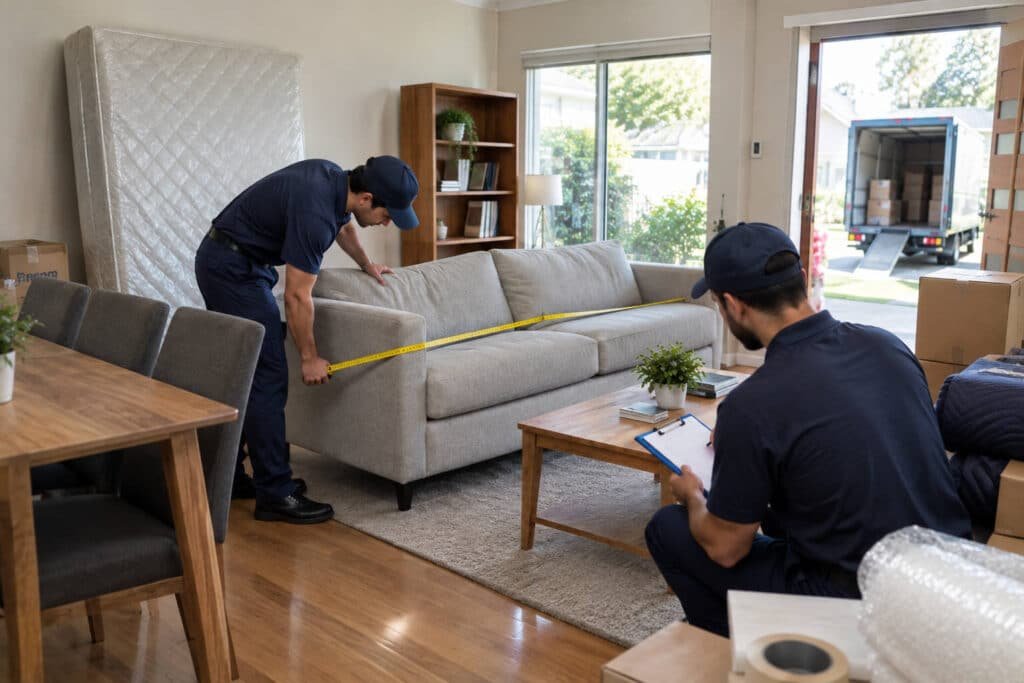
Quick answer: Measure the length, width and height of each item in metres. Multiply the three numbers to get its cubic metres (m³). Add all items together, then add 10–15% extra for gaps and packing. That final number is what most removalists use to quote your interstate move.
Why do cubic metres matter?
When you move interstate, the truck space you need decides most of your price. Removalists charge by volume, not by how many items you own. If you guess too low, you might get hit with extra costs on moving day. If you guess too high, you pay for space you don’t use.
Knowing your m³ also helps you compare quotes fairly. Two companies might offer different prices, but if both use the same volume, you can see who is actually cheaper.
What you need before you start
Grab these before you walk through the house:
- A tape measure (metric side)
- Pen and paper, or the notes app on your phone
- A calculator
Work at your own pace. Measuring one room at a time is much easier than trying to measure the entire house all at once.
Step-by-step: how to calculate cubic metres
Step 1: Measure in metres. Measure the longest side (length), the shorter side (width) and the height. If your tape shows centimetres, divide by 100. For example, 180 cm is 1.8 m.
Step 2: Multiply the three numbers. Use this simple formula:
Length × Width × Height = cubic metres
A two-seater couch that is 1.8 m long, 0.9 m wide and 0.85 m high works out like this: 1.8 × 0.9 × 0.85 = 1.38 m³.
Step 3: Write it down. Note each item and its volume as you go. A simple list per room keeps things tidy.
Step 4: Add it all up. Once every room is done, total the numbers.
Step 5: Add a buffer. Furniture never packs perfectly. Odd shapes leave gaps, and you will find extra stuff in the garage. Add 10–15% to your total to stay safe.
Typical furniture sizes (rough guide)
If you can’t measure something yet, these averages can help you plan:
| Item | Approx. volume |
| Queen bed (with base) | 1.5–2 m³ |
| 3-seater couch | 2–2.5 m³ |
| Dining table (6 seats) | 1.2–1.5 m³ |
| Fridge (large) | 1–1.5 m³ |
| Washing machine | 0.5–0.7 m³ |
| Wardrobe (2-door) | 1.5–2 m³ |
| Standard moving box | 0.06–0.1 m³ |
Treat these as a starting point only. Measuring everything yourself will give you the most accurate results.
How do you measure odd-shaped furniture?
Not everything is a neat box. For L-shaped couches, round tables or chairs with sticking-out arms, measure the widest points on each side. Imagine wrapping the item in a box and measure that box. It may give you a slightly higher number, but that’s fine, because the truck space it takes up is closer to that box than to the real shape.
Here are a few tips for tricky items:
- Tables: If the legs come off, measure the top and legs separately. Flat items stack well and take less room.
- Beds: Count the base and mattress separately, or measure them stacked.
- Chairs: Measure one and multiply by the number you have, but remember that stackable chairs take less space.
Don’t forget boxes and small items
This is where many people go wrong. Boxes, bags, lamps, pot plants and the stuff in your shed add up quickly. A good rule is to count your boxes and multiply by about 0.07 m³ for an average size. Fifty boxes works out to roughly 3.5 m³.
How many cubic metres does an average home need?
Here’s a rough idea for planning:
- 1-bedroom unit: 10–15 m³
- 2-bedroom home: 20–30 m³
- 3-bedroom home: 30–45 m³
- 4-bedroom home: 45–60 m³
If your total looks very different from these numbers, double-check your sums.
Common mistakes to avoid
- Measuring in centimetres and mixing units. Stick to metres the whole way.
- Skipping the garage, shed and balcony. Removalists will include them, so you should too.
- Forgetting the buffer. Always add that extra 10–15%.
- Not decluttering first. Every item you sell or donate before the move saves you money. Sort your things before you measure.
Quick tip: use an online calculator or ask for a free quote
If you don’t feel like doing the maths, many removalists offer an online volume calculator or a free in-home or video quote. It’s still smart to do your own rough count first. That way you can spot a quote that seems too high or too low.
FAQs
What is a cubic metre in moving?
It’s the amount of space taken up by an item that is 1 metre long, 1 metre wide and 1 metre high. Removalists use it to measure how much truck space you need.
How do I calculate cubic metres from centimetres?
Multiply length × width × height in centimetres, then divide by 1,000,000. Or convert each side to metres first, which is usually easier.
Should I measure every single item?
Measure the big pieces and count the boxes. For small items, use averages and add your buffer.
How much extra should I allow?
Add about 10–15% to your total for gaps, awkward shapes and last-minute items.
Measure early and save money on moving day
Working out your cubic metres doesn’t need to be stressful. Measure each item, multiply, add it up and include a small buffer. It takes an hour or two, but it can save you real money and avoid surprises on moving day. Do it a few weeks before your move, so you have time to get quotes and sort through your things.
